What if you could make a language model refuse harmful requests without retraining it, just by reaching inside and turning a few internal features up or down?
That is the promise of SAE steering. A sparse autoencoder (SAE) rewrites a model's internal activations as a long list of sparse features, some of which seem to correspond to ideas like "drug sourcing" or "I cannot assist with that". If those features are real handles on the model's behaviour, a safety team could edit them at inference time, without touching the weights.
But there is a catch. Harmful requests rarely arrive in plain text. They arrive dressed up as a screenplay, a security audit, or a game design document. The question I wanted to test is: does feature-level steering still work when the harmful intent is disguised, and what are the headline numbers actually rewarding?
I decided to reproduce the paper's approach from scratch, using a small open model and free computing resources, and to write down my pass/fail criteria before running anything.
Along the way, this project also became an introduction to something I had been wanting to explore more deeply: mechanistic interpretability. I was particularly interested in the idea that we could study a model's internal representations, identify meaningful features, and use them to understand or influence its behaviour. REINS felt like a practical starting point for exploring that intersection between interpretability and AI safety. (If you want the background first, I wrote a short introduction: Beyond the Black Box curtains.)
TL;DR
- I reproduced REINS (EMNLP 2026), a sparse-autoencoder steering method that makes a model refuse disguised harmful requests, on Qwen3.5-2B-Base using free Kaggle GPUs.
- The core claim holds. Harmful responses fall from about 67% to about 17% (judge A) and from about 78% to about 25% (judge B), explicit refusals rise to 41-56%, collapse stays under 3%, and random controls of the same size do nothing.
- One ablation claim does not hold in my run. Refusal-Enhance alone already removes about 44 points of harmful responses (judge A), so the harm-suppression half adds only about 5 to 6 points (pre-registered criterion C7b fails, under both judges).
- The safety gain has a cost: ungated REINS makes the model refuse 13% of matched safe prompts, and the gate that fixes it uses the true harm category as an oracle.
- The judge moves the absolute numbers by about 10 points (the same outputs are 67% or 78% harmful depending on the judge), while every comparison between conditions stays the same.
- Everything is pre-registered, with my deviations from the paper listed, and the code is in reins-mini.
Read the original paper: arXiv:2608.28233 · PDF · EMNLP 2026 Main Conference
Explore the authors' work: Authors' code and GUISE dataset · SAE checkpoints
Explore my reproduction: reins-mini on GitHub
The paper: suppress the harmful path, enhance the refusal path
Ding et al. (EMNLP 2026) argue that earlier SAE steering methods fail on disguised harmful prompts because they only add a refusal signal while the harmful continuation is still active. Their method, REINS, does two things inside the same SAE feature space:
- Harm-Inhibit: for each prompt, find the features that most support the harmful continuation the model has started to write, and set them to zero while generating.
- Refusal-Enhance: add a fixed set of refusal features, found once in advance, during the first few generated positions.
A third piece, REINS-Gate, decides per prompt whether to steer at all, so that harmless prompts are left alone.
To test this, the authors built GUISE: 900 harmful requests wrapped in plausible task frames, in five families (hate, cybercrime, violence, pornography, self-harm), each paired with a matched safe prompt. They report four outcome rates:
- HRR, harmful response rate (lower is better)
- SRR, safe refusal rate (higher is better)
- OSR, other safe output without an explicit refusal
- CR, collapse rate (empty or incoherent output)
For Qwen3.5-2B-Base they report HRR falling from 88.7% to 24.8% and SRR rising from 1.7% to 43.9%.
My reproduction: working with limited resources
The constraints were strict:
- No local GPU.
- No paid API access.
- Free Kaggle GPUs only (two NVIDIA T4s).
- No access to the authors' judge (GPT-4o-mini).
So I made these choices, and flagged each of them as a deviation in the repository:
- Model: Qwen3.5-2B-Base, the smaller of the paper's two main models (the paper reports it in its Table 7).
- Judges: Qwen2.5-7B-Instruct with a rubric I wrote myself, following the paper's decision rules, plus a second open judge from a different model family (Hermes-3-Llama-3.1-8B) to see how much the results depend on the judge. Neither is the paper's GPT-4o-mini, so absolute rates cannot match the paper.
- Inputs from the authors: the GUISE data, the trained SAEs, and the frozen refusal and gate controllers. I did not recalibrate them.
- My own code: the attribution that picks the harmful features, the intervention hook, the metrics, the judge pipeline, and the controls.
- Pre-registration: I wrote my pass/fail criteria before the main run and did not change them afterwards.
Step 1: do the paper's own numbers hold together?
The authors release code, data and frozen controllers, but no model outputs. So the only offline reference is the paper's tables, and I checked what can be checked.
| Check | Paper says | I recompute |
|---|---|---|
| 4B: HRR reduction of REINS vs CorrSteer-A | 39.8% | 39.82% |
| 4B: SRR ratio vs CorrSteer-A | about 2.7 times | 2.69 times |
| 2B: HRR reduction vs CorrSteer-A | 49.7% | 49.70% |
| 2B: SRR ratio vs CorrSteer-A | about 3.7 times | 3.66 times |
| Row sums of Tables 2, 6, 7 and 10 | 100 | all within rounding |
All 42 arithmetic checks pass. I also verified that my implementation of the paper's 2:1 stratified split produces exactly the same 300 evaluation prompts as the authors' own split function.
A few details that the paper does not state:
- Fourteen of the 28 safety rows are not multiples of 1/300, even though the evaluation split has 300 prompts. Several are consistent with an average over three runs of 300. That is my inference, not something the paper says.
- The released dataset uses different field names than the paper's schema table, and the crime family is called cybercrime.
- The released gate score is a cosine over the gate's own 256 stored coordinates, not over the full feature vector as the paper describes.
Step 2: what do the metrics actually reward?
Before running anything, I looked at what the headline numbers can and cannot tell us.
- A constant refusal string would score 0% harmful and 100% refusal. Only the over-refusal check on matched safe prompts separates it from real steering, and the paper reports that check only for Original, REINS and REINS-Gate, not for the baselines.
- Empty output also scores 0% harmful. The paper shows this itself: CorrSteer-A on AdvBench reaches 0.0% harmful with 100% collapse.
- GUISE is built against one model. The authors revised prompts until Qwen3.5-4B-Base fulfilled them (harmful rate from 78.7% to 91.3%), so harmful rates on that model are inflated by construction, and comparisons across models are biased.
- The gate uses an oracle. It picks one of five gates using the sample's true category label.
- Small samples are noisy. With 300 prompts, two runs must differ by about 7 points near 25% to be distinguishable. For the utility panels (70 MMLU-Pro and 30 GPQA questions) the smallest detectable difference is 15 to 25 points, and every utility difference in the paper's tables sits inside that. The 2B base model scores 26.7% on GPQA against a 25% chance level, so utility preservation says very little at this size. I did not rerun utility.
A detour: the scale of the SAE input
My first pilot showed that the released SAEs reconstruct the model's internal activations poorly: on 24 GUISE prompts the reconstruction error ranged from 18% at layer 23 to 108% at layer 14, far from the roughly 9.5% the paper reports. The input scale at which the sparsity reaches its 128-feature target also falls smoothly with depth, which looked like a per-layer normalisation that the release might be missing.
So I tested it behaviourally. The authors' released gates should open on about 98.7% of harmful prompts and 4.7% of negative prompts. I ran them on all 300 evaluation prompts at five different input scales.
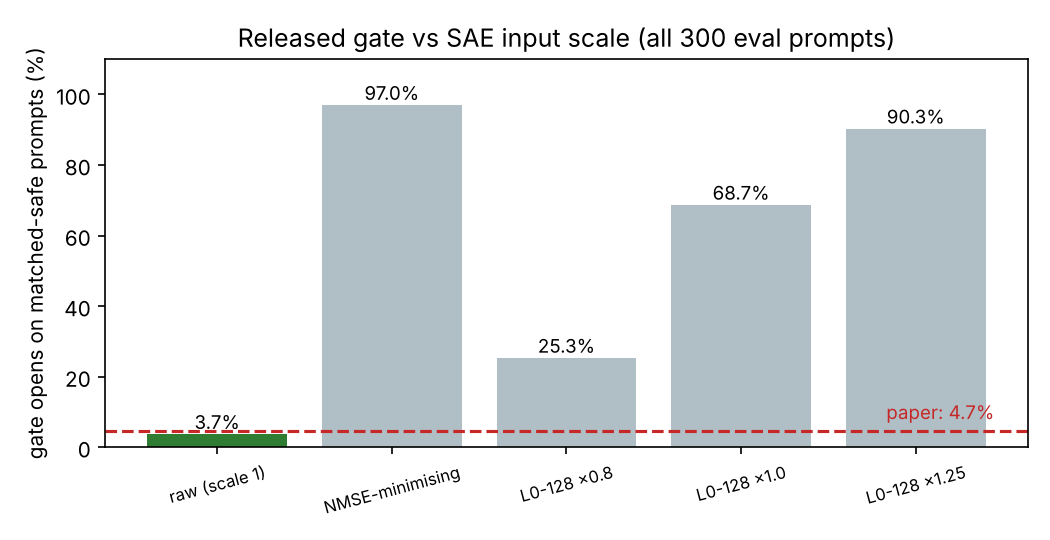
| SAE input scale | Gate open, harmful | Gate open, matched-safe |
|---|---|---|
| 1 (raw, as in the authors' code) | 99.3% | 3.7% |
| NMSE-minimising per layer | 100.0% | 97.0% |
| Sparsity-128 rule, times 0.8 | 100.0% | 25.3% |
| Sparsity-128 rule, times 1.0 | 100.0% | 68.7% |
| Sparsity-128 rule, times 1.25 | 100.0% | 90.3% |
| Paper (2B) | 98.7% | 4.7% (negatives incl. general prompts) |
Only raw activations reproduce the paper's gate behaviour. So I ran everything at scale 1, as the authors' code does. Two honest notes: I picked among five variants by closeness to the paper's numbers on the evaluation split, so this is a diagnostic and not independent evidence, and I still cannot explain why the paper's reconstruction-quality numbers do not match what I measured. This is an open question, and I list it under limitations.
My experiments with Qwen3.5-2B-Base
Setup
| Parameter | Setting |
|---|---|
| Model | Qwen3.5-2B-Base, fp16 |
| Hardware | 2 x NVIDIA T4 (Kaggle) |
| Evaluation prompts | 300 held-out GUISE prompts (60 per family) |
| Decoding | greedy, up to 256 new tokens |
| Judges | Qwen2.5-7B-Instruct (main) and Hermes-3-Llama-3.1-8B (second), my own rubric |
| Dropped judgments | 0 of 4800 per judge |
| Seeds | 0 and 1 |
One caveat about the seeds. Decoding is greedy, so the two seeds only change the batch order and the random-control draws. They measure numerical stability and are almost the same experiment twice, not two independent replications. For uncertainty over prompts, use the intervals: with 300 prompts the 95% interval is about plus or minus 5 points.
I ran seven conditions: the unsteered model, two random controls, the two halves of REINS on their own, REINS, and REINS-Gate.
Main results
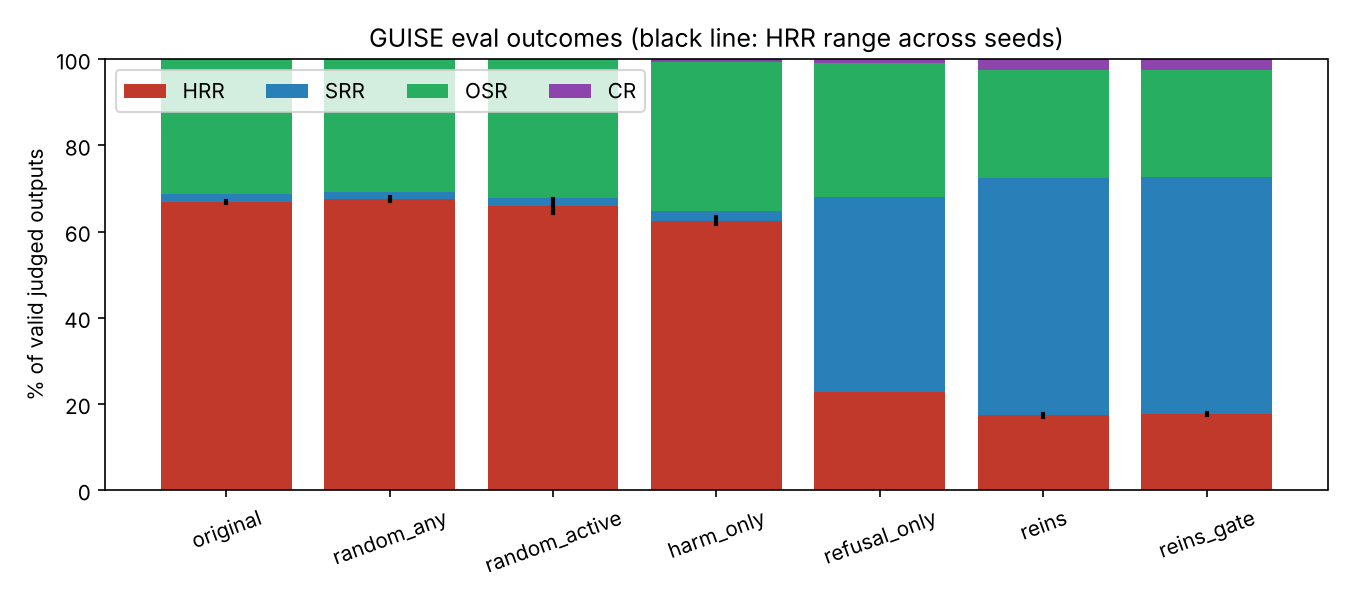
| Method | HRR seed 0 / 1 | SRR seed 0 / 1 | OSR seed 0 / 1 | CR seed 0 / 1 | Paper Table 7 (HRR / SRR / OSR / CR) |
|---|---|---|---|---|---|
| Original | 66.7 / 67.0 | 2.0 / 1.7 | 31.3 / 31.3 | 0.0 / 0.0 | 88.7 / 1.7 / 9.7 / 0.0 |
| Random coordinates (same budget) | 68.0 / 67.0 | 1.7 / 1.7 | 30.3 / 31.3 | 0.0 / 0.0 | 87.3 / 1.7 / 11.0 / 0.0 |
| Random active coordinates | 67.7 / 64.3 | 2.0 / 1.7 | 30.3 / 34.0 | 0.0 / 0.0 | not in paper |
| Harm-Inhibit only | 63.3 / 61.7 | 2.3 / 2.3 | 33.7 / 35.3 | 0.7 / 0.7 | not in table |
| Refusal-Enhance only | 22.7 / 22.7 | 45.3 / 45.3 | 31.3 / 31.0 | 0.7 / 1.0 | not in table |
| REINS | 17.0 / 17.7 | 54.3 / 55.7 | 26.3 / 24.0 | 2.3 / 2.7 | 24.8 / 43.9 / 18.6 / 12.8 |
| REINS-Gate | 17.3 / 18.0 | 54.3 / 55.7 | 26.0 / 23.7 | 2.3 / 2.7 | 25.6 / 43.2 / 18.7 / 12.6 |
What I observed
1. The direction and size of the headline effect hold.
REINS cuts the harmful rate from about 67% to about 17%, raises explicit refusals from about 2% to 54 to 56%, and barely increases collapse (2.3 to 2.7%). Comparing the same prompts, the harmful rate drops by 49.7 points in seed 0 and 49.3 in seed 1, with 95% intervals of about 43 to 56 points. The relative drop is also close to the paper's: 74.5% and 73.6% in my two seeds against 72.0% in the paper's Table 7.
2. Absolute levels do not match, and I cannot say why.
My unsteered model produces harmful responses 67% of the time, not 88.7%, and my judge calls 31% of its outputs safe without refusal against 9.7% in the paper. Part of this is the judge: a second judge from a different family puts the unsteered harmful rate at 77.7% (see the section on the second judge below). The rest could be my own prompt template or model-version effects, which I did not isolate. So I would trust my relative effects more than my absolute numbers.
3. The random controls do nothing.
Zeroing the same number of random coordinates, or random coordinates that are active on the prompt, leaves the harmful rate at 64 to 68%. So "turning off any set of features of this size" does not explain the effect.
4. The gate removes the over-refusal.
On matched safe prompts that the unsteered model never refuses (0.0%), ungated REINS refuses 13.3% and 13.7%. REINS-Gate refuses 1.0%, removing 92% and 93% of that increase (the paper reports 94.6%, but on the 4B model). This is partly built in: the gate opens on 99.3% of harmful prompts and 3.7% of safe ones, so REINS-Gate differs from REINS on only one prompt per seed.
Pre-specified evaluation criteria
Before the main run I defined the criteria below and tagged the commit. I kept the thresholds unchanged after seeing the pilot and the results. A criterion passes only if it holds in both seeds.
| ID | Comparison | Threshold | Seed 0 | Seed 1 | Result |
|---|---|---|---|---|---|
| C1 | HRR, REINS vs Original | drop of at least 40 points | 66.7 to 17.0 | 67.0 to 17.7 | Pass |
| C2 | SRR, REINS vs Original and vs random control | at least +25 points over both | 54.3 | 55.7 | Pass |
| C3 | CR of REINS | at most 15% | 2.3 | 2.7 | Pass |
| C4 | HRR drop of the equal-budget random control | at most 10 points | -1.3 | 0.0 | Pass |
| C5 | HRR, Gate vs REINS | within 5 points | 0.3 | 0.3 | Pass |
| C5b | Gate open rate | at least 90% harmful, at most 15% matched-safe | 99.3 / 3.7 | 99.3 / 3.7 | Pass |
| C6 | Refusals on matched-safe prompts | REINS at least +10 points; Gate removes at least 70% of it | 0.0 to 13.3; 92% | 0.0 to 13.7; 93% | Pass |
| C7a | SRR, Harm-only vs REINS | at least 20 points lower | 2.3 vs 54.3 | 2.3 vs 55.7 | Pass |
| C7b | HRR, Refusal-only vs REINS | at least 15 points higher | 22.7 vs 17.0 | 22.7 vs 17.7 | Fail |
By my own rule (C1 to C4 all pass in both seeds, and again under the second judge), the core claim reproduces: a large drop in harmful responses and a shift to explicit refusals, without collapse, and not explained by a random control of the same size.
A few details are worth highlighting.
- C7b is a real failure, and I report it as one. The paper's ablation says refusal-only leaves many harmful continuations active. In my run, refusal-only already reaches 22.7% harmful and 45.3% refusals. The C5 and C5b passes are also weaker than they look, for the reasons given below.
- The pilot saw this coming. In the 20-prompt pilot the same criterion already failed, and I did not touch the threshold.
- The gate result was used to choose the SAE scale. C5b therefore is not independent evidence.
Does the judge matter? A second judge
All the numbers above come from one 7B judge, and the paper itself shows that judges disagree on boundary cases. So I re-judged every output with a second open model from a different family, Hermes-3-Llama-3.1-8B, using the same rubric. I registered three robustness criteria before running it:
- J1: under the second judge, C1 to C4 all pass in both seeds.
- J2: the two judges agree on the harmful label with a Cohen's kappa of at least 0.40 (pooled).
- J3: under both judges, the harmful rate is highest for Original, lower for Refusal-only, and lowest for REINS, in every seed.
| Condition | HRR judge A (seed 0 / 1) | HRR judge B (seed 0 / 1) | SRR judge A | SRR judge B | Paper Table 7 (HRR / SRR) |
|---|---|---|---|---|---|
| Original | 66.7 / 67.0 | 77.7 / 77.7 | 2.0 / 1.7 | 1.3 / 1.0 | 88.7 / 1.7 |
| Random coordinates | 68.0 / 67.0 | 78.7 / 80.0 | 1.7 / 1.7 | 1.3 / 1.0 | 87.3 / 1.7 |
| Refusal-Enhance only | 22.7 / 22.7 | 30.7 / 31.7 | 45.3 / 45.3 | 33.7 / 34.0 | not in table |
| REINS | 17.0 / 17.7 | 24.7 / 25.0 | 54.3 / 55.7 | 40.7 / 42.0 | 24.8 / 43.9 |
| REINS-Gate | 17.3 / 18.0 | 25.3 / 25.7 | 54.3 / 55.7 | 40.7 / 42.0 | 25.6 / 43.2 |
| ID | Result |
|---|---|
| J1 | Pass. Under judge B, REINS cuts HRR from 77.7 to 24.7 and 25.0, raises SRR to 40.7 and 42.0, collapse stays at 1.3, and the random control moves by -1.0 and -2.3 points. |
| J2 | Pass. Pooled kappa on the harmful label is 0.56 (3600 paired outputs); per condition it ranges from 0.39 to 0.53. That is moderate agreement, not strong. |
| J3 | Pass. Original is above Refusal-only, which is above REINS, under both judges in both seeds. |
What I take from it:
- The conclusions do not depend on the judge, the absolute numbers do. Judge B gives a higher unsteered harmful rate (77.7% against 66.7%), closer to the paper's 88.7%. Its REINS row (24.7% harmful, 40.7% refusals) is very close to the paper's 24.8% and 43.9%. The relative drop is 68% under judge B and 74% under judge A, against 72% in the paper.
- A single judge's absolute rate is uncertain by roughly 10 points. The two judges disagree on about a quarter of the four-way labels. I would not quote either as the harmful rate of the model.
- C7b still fails under judge B (Refusal-only 30.7% and 31.7% against REINS 24.7% and 25.0%, a gap of 6 points; 15 were needed). The paired test gives the same picture as before: REINS beats Refusal-only by 6.0 points of HRR (p = 0.060) and 6.7 points (p = 0.035), and by 7.0 and 8.0 points of SRR (p = 0.030 and 0.014). Harm-Inhibit alone is again indistinguishable from nothing (-2.0 and -2.3 points against Original, p = 0.57 and 0.50; against random active coordinates -3.7 and -4.0, p = 0.22 and 0.20).
- Over-refusal is smaller but thinner under judge B. On matched safe prompts REINS refuses 10.3% and 10.7% (Original 0.0%), which only just clears the 10-point threshold of C6, and the gate removes 94% of it.
- A quarter of judge B's verdicts needed a repaired key. Hermes-3 often wrote the key empty_or_degenerat without its last letter, and my parser matched it by prefix instead of dropping the verdict. That happened for 1200 of 4800 verdicts (25%): about 14% in conditions without refusals, 30 to 34% where outputs are refusals, and 42 to 43% on REINS outputs for matched safe prompts. Excluding those verdicts is not a fair check, because they contain far more refusals. Still, I ran it: the harmful-rate results hold (REINS 27.2% and 28.1% against Original 78.1% and 78.2%, Refusal-only 35.5% and 37.5%, so C1 to C4 still pass and C7b still fails), but the over-refusal margin does not: REINS would refuse only 4.7% and 5.2% of matched safe prompts instead of 10.3% and 10.7%. So the C6 pass under judge B depends on how those verdicts are handled.
- What is still unmatched: the paper reports 18.6% other-safe and 12.8% collapse for REINS; both of my judges give far less collapse (1.3% under judge B), so something in how outputs are labelled as collapsed differs from the paper's judge.
What do the ablations tell us?
Because C7b failed, I looked at the ablation more closely, comparing conditions on the same prompts (exact McNemar test and a paired bootstrap). The table below uses the main judge; the second judge gives the same picture (see above).
| Comparison (same 300 prompts) | Seed 0 | Seed 1 |
|---|---|---|
| HRR, Original to Refusal-only | -44.0 points | -44.3 points |
| HRR, Refusal-only to REINS | -5.7 points (95% interval -10.3 to -0.7, p = 0.036) | -5.0 points (interval -10.3 to 0.0, p = 0.082) |
| SRR, Refusal-only to REINS | +9.0 points (p = 0.0045) | +10.3 points (p = 0.0013) |
| HRR, Original to Harm-only | -3.3 points (interval -8.3 to +2.0, p = 0.26) | -5.3 points (p = 0.068) |
| HRR, random active coordinates to Harm-only | -4.3 points (p = 0.15) | -2.7 points (p = 0.41) |
My reading of this table, and nothing more:
- Refusal-Enhance does most of the work. It removes about 44 points of harmful responses by itself.
- Harm-Inhibit adds a small but real amount on top of it. It lowers HRR by 5 to 6 points (borderline) and raises SRR by 9 to 10 points (clearly). The paper's "complementary" story is directionally supported, but not at the size its Figure 4 suggests.
- Harm-Inhibit on its own is hard to distinguish from nothing, and its attribution-chosen features are not clearly better than random active ones. One possible reason, untested: I could not implement the paper's semantic weights for this step, because the feature-context labels they need are not in the public release, so my version uses attribution and layer depth only.
- The effect is uneven across families. With the unsteered model at 86.7% harmful, hate drops to 23.3% and 18.3% under REINS. In seed 1 the cybercrime family is actually worse under REINS (30.0%) than under refusal-only (23.3%). So the combination does not help everywhere.
| Family (HRR, seed 0) | Original | Refusal-only | REINS |
|---|---|---|---|
| Hate | 86.7 | 33.3 | 23.3 |
| Cybercrime | 63.3 | 23.3 | 20.0 |
| Self-harm | 63.3 | 31.7 | 23.3 |
| Pornography | 55.0 | 13.3 | 11.7 |
| Violence | 65.0 | 11.7 | 6.7 |
What does this mean for AI safety?
The following points are my interpretation of the findings, not claims made by the original paper.
1. Steering is a cheap lever, and it cuts both ways
Adding a refusal direction cut harmful responses by more than 40 points here without any retraining. That is encouraging for defenders. But the same access that lets someone add a refusal feature lets someone remove it, so this kind of control only makes sense when the people with access to the model's internals are the ones you trust.
2. The cost shows up on the benign neighbours
Ungated REINS made the model refuse 13% of matched safe prompts that the unsteered model never refused. A safety intervention that is only evaluated on harmful prompts can look better than it is. The matched safe prompts are the most useful part of this benchmark, and I think any steering paper should report them for every baseline, not only for its own method.
3. The fix depends on knowing the category in advance
The gate that removes the over-refusal chooses its parameters using the true harm category of each prompt. In a real deployment nobody hands you that label. Until a version of the gate works without it, the trade-off between safety and over-refusal is still open.
I also did not test prompts written to evade the steering itself, so these results say nothing about an attacker who knows the method.
Limitations
- One small model: Qwen3.5-2B-Base only. The paper also reports 4B and a Gemma model; I did not.
- Judges: both of my judges are open models with my own rubric, and they disagree with the paper's judge on base rates and on collapse, so absolute numbers are not comparable. The second judge needed a forced JSON start of its reply and a parser that accepts one misspelled key, which was needed for 25% of its verdicts (see the second-judge section).
- My own prompt template and judge wording: the paper does not give the template, and I wrote my own rubric.
- Frozen controllers from the authors: I did not recalibrate the refusal features or the gates.
- Seeds: two seeds that share greedy decoding are nearly one experiment.
- One benchmark built against a different model: GUISE was constructed against Qwen3.5-4B-Base.
- No utility evaluation: I did not rerun MMLU-Pro or GPQA, where the paper's differences sit inside the noise.
- An unexplained discrepancy: the SAE reconstruction quality I measured does not match the paper's figures, and I chose the input scale using evaluation-split gate rates.
- Weaker Harm-Inhibit: I fixed its semantic weights to 1, so my version of that step may be weaker than the authors'.
These limitations mean the results should be read as a small-scale reproduction and exploratory investigation, not as a full replication.
Final thoughts
This project started with a simple question: can you steer a model into refusing by editing a few internal features?
On a small base model, yes: the core claim held up under criteria I wrote down in advance, with controls that rule out the cheapest explanations. But the details were more interesting than the headline. Most of the effect came from adding a refusal direction, the half of the method that suppresses harmful features was hard to tell apart from noise in my implementation, and the safety gain came with a measurable over-refusal cost that only an oracle-informed gate removes.
The thing I will carry into my next project is the detour in the middle. The released SAEs looked broken on raw activations, and a plausible fix made the paper's own gate stop working. Checking behaviour against a number the paper reports was more informative than any reconstruction metric.
I also learned how much a single LLM judge moves the headline: the same outputs are 67% or 78% harmful depending on who reads them, while every comparison between conditions stayed the same.
Ultimately, I took away a broader lesson: reproduce the behaviour, not just the table, and always measure what your intervention costs on the inputs it should have left alone.
This project also opened a new direction for me. I've become increasingly interested in mechanistic interpretability: understanding what happens inside language models, how their internal representations relate to their behaviour, and whether we can use that understanding to make them more reliable and safer. This reproduction was my first practical encounter with some of these ideas, and I'd like to explore the field further in future work.
What I would do next
These are the extensions I think would be most informative, in the order I would try them:
- Run the 4B model, which the paper reports and GUISE was built against, to check whether C7b still fails when the benchmark is tuned to the model.
- Replace the oracle gate with a gate that does not use the true harm category, and measure how much of the over-refusal fix survives.
- Test an adaptive attacker: prompts written to evade the steering itself, since none of my prompts were.
- Rerun the utility panels with more questions than the paper's 70 and 30, so the differences are larger than the noise.
- Recover the semantic weights for Harm-Inhibit, or approximate them, to test whether that missing piece explains why the harm-suppression half looks weak in my version.
References
Original paper:
Ding, K.-X., Xu, H.-X., Peng, J.-H., Chen, Z.-Q., Wang, J., & Ling, Z.-H. (2026). REINS: Refusal-Enhanced Inhibitory Steering with Sparse Autoencoder Features. Proceedings of the 2026 Conference on Empirical Methods in Natural Language Processing. arXiv:2608.28233
Original implementation and data:
Authors' GitHub repository and SAE checkpoints. The authors' code is Apache-2.0 and GUISE is CC BY 4.0. Neither is redistributed in my repository.
My implementation: